
Packaging Weight Reduction: Cutting 12–16% of Plastic Without Losing Strength
Resin is usually the largest line in a container's unit cost, and most containers carry grams that do no work. Geometry — not thinner walls — is how 12–16% of the plastic comes out with top-load and drop performance intact.
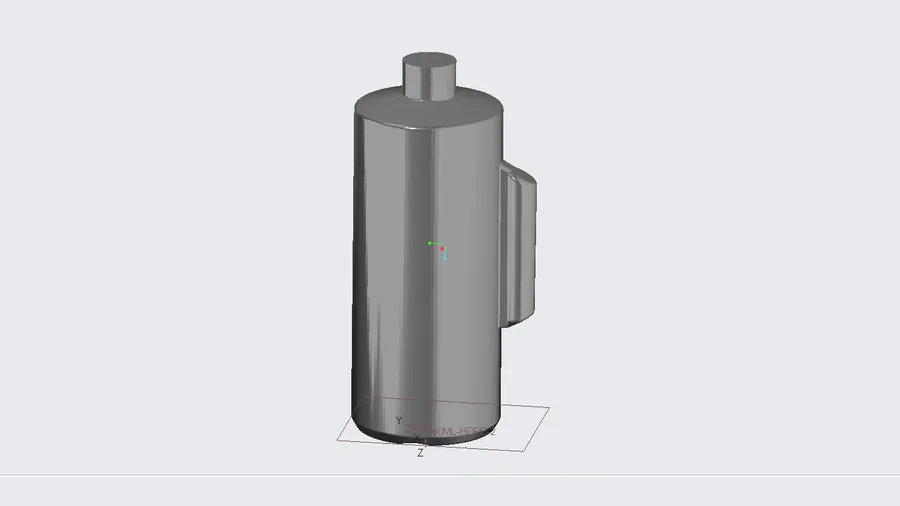
A 5-liter engine oil container at 250 grams and one at 210 grams can hold the same five liters, ride the same pallet and pass the same drop test. The difference between them is 40 grams of polyethylene — and 40 grams, multiplied by every unit a line will ever produce, is one of the largest sums in packaging that never appears on an invoice.
What packaging weight reduction actually means
Packaging weight reduction is the redesign of a container's geometry — ribs, corner radii, shoulder transitions, base shape, handle structure — so that material sits where loads actually travel, rather than making every wall uniformly thinner. Redesigned this way, bottles and jerrycans typically give up 10–16% of their plastic while keeping their top-load and drop performance. Advanced Molds Technologies proves these designs in simulation and validates final weights in prototype and production trials, because a gram saved on screen only counts once it survives a real machine.
Grams are the unit of money
Resin is typically the largest single share of a blow-molded container's unit cost; for commodity packaging, resin cost commonly exceeds machine time, energy and mold amortization put together. That makes weight the one number every plant manager can act on: grams per unit, times units per year. Forty grams saved on the 5-liter container above, on a line running two million units a year, is eighty tonnes of HDPE that will never be bought, melted, shipped or disposed of — every year, for the life of the design.
The arithmetic compounds across a range. We recently developed a family of engine oil containers for a lubricants brand in the region — 5L, 4L and 1L designed as one coherent system — with development targets of 210, 200 and 70 grams against typical current weights of 250, 240 and 80. Roughly 12–16% less plastic in every size, and none of it from thinner walls.
Why naive thin-walling fails
The obvious way to chase grams is to run the same shape with less material in it. It fails in predictable ways. Top load is a buckling problem: a panel's resistance to collapse grows with the cube of its effective depth, so a flat wall loses stiffness far faster than it loses weight. Drop performance goes next, because the thinnest points of a blow-molded container — corners, pinch lines, the far side of deep features — are where uniform thinning bites first. Then come the slower failures: panels that warp as uneven walls cool unevenly, and large flat faces that oil-can — popping in and out under a thumb or the slight vacuum of cooling product.
Strength was never in the thickness alone; it is in where the thickness sits. A container survives three pallets of stacking with geometry, and geometry is exactly what naive lightweighting leaves untouched.
The geometry toolbox
This is structural optimization in the plainest sense: the shape starts doing the work the material used to do.
- Ribs: a rib deepens a panel's section without adding material, and stiffness scales with depth cubed. On large flat faces — jerrycan sides, label-free zones — millimeters of well-placed rib replace grams of wall. A moulded rib costs nothing at the machine.
- Corner radii: the parison stretches farthest into sharp corners, so tight radii are automatically the thinnest, weakest points. Generous radii keep the wall even and spread drop impact instead of concentrating it.
- Load paths: stacking load should travel from the neck through near-vertical walls and land on the base's standing ring. Every jog between shoulder and heel is a hinge that turns compression into bending, and bending is what collapses panels.
- Base geometry: a domed or push-up base resists the outward bulge of a full container and defines the ring the whole stack stands on. Flat bases look simple and fail early.
- Shoulder transitions: gradual shoulders let the process lay material down evenly; abrupt ones create thin bands exactly where top load concentrates.
- Handle structure: a handle is a beam, and a beam's strength lives in its cross-section, not its bulk — which is why a well-sectioned handle can lose weight and gain stiffness at once.
The process decides where the grams land
None of this can be designed against an imaginary uniform wall, because blow moulding never produces one. In extrusion blow molding, wall thickness is distributed: parison programming meters material along the container's height, and the blow-up ratio decides how much each region thins as it reaches the cavity. In injection stretch blow molding, the stretch ratios of the preform play the same role. The practical consequence is that a lightweight design and its process window have to be developed together — a shape drawn for a wall the process cannot deliver is a rendering, not a container. It is one reason design house and mold maker belong under one roof.
Proof before steel
Every claim above can be checked before steel is cut, and should be. We run wall thickness, top load and drop in simulation until the design stops producing surprises, then 3D-print a prototype to validate what software cannot: grip, pouring, how the family stacks and reads together. Final weights are confirmed only in production trials, because the achieved gram depends on material, machine, mold and process — which is why honest weight reduction talks in targets and validation, not promises.
The sustainability arithmetic, honestly
Lightweighting is a material reduction that needs no asterisk. Eighty tonnes of resin not purchased is eighty tonnes not produced, not trucked across a border and not sent to disposal after use. The saving is physical, and it lands on the cost line and the waste stream at once. For brands filling in Jordan, the GCC and the wider MENA region, the honest claim is also the simplest one: the container does the same job with less material in it.
Packaging weight reduction, answered
How much weight can be removed from a plastic bottle?
When the geometry is genuinely redesigned rather than uniformly thinned, 10–16% is an industry-typical range for bottles and jerrycans, and designs that were never optimized can give up more. The final figure is always confirmed in prototype and production trials, because achieved weight depends on material, machine, mold and process — not on the CAD file alone.
Does a lighter bottle mean a weaker bottle?
Not if the grams come out of places where they were doing no work. Top-load and drop performance come from geometry — ribs, radii, load paths, base shape — far more than from raw thickness, so a well-designed 210-gram container can outperform a lazily designed 250-gram one. The way to know is to test both, in software and then physically.
Where do the weight savings actually come from?
From geometry, not from walls. Ribs deepen sections without adding material, radii stop corners from thinning, straight load paths let stacking forces travel through the wall instead of bending it, and base and shoulder shapes control where the process places material. Uniform thinning is the one method that reliably fails.
Does lightweighting require a new mold?
Usually, yes. A genuine redesign changes the cavity surfaces, corner radii, base and pinch-off geometry, so it is normally a new mold rather than a rework of the old one. That makes lightweighting the right moment to fix ergonomics, stackability and family coherence in the same tool — and why proving the design in simulation first matters: a new mold should not be a gamble.
From target to steel
A current container and its weight are enough to start the conversation.
Advanced Molds Technologies is a product design house and precision mold maker in Amman, Jordan, serving Jordan, Saudi Arabia, the GCC and the wider MENA region — the same team that draws the geometry builds the tool that produces it. Our packaging product design services take a container from brief to validated prototype, and our mold making turns the result into steel.


