
Why We Test Packaging in Software Before We Cut Steel
A digital-first approach to wall thickness, material distribution and cooling, and why the cheapest place to discover a problem with a bottle is on a screen, not in a mould trial.
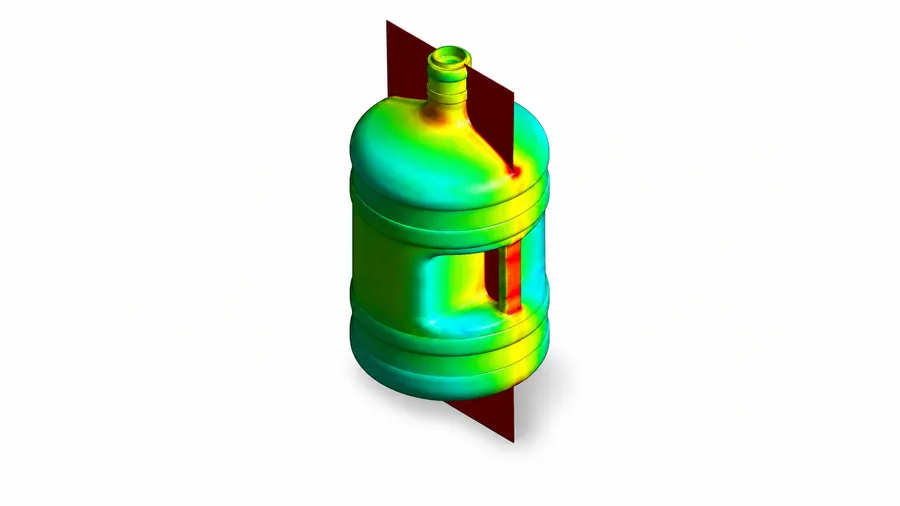
There is a moment in every tooling programme where a decision stops being cheap. It is not when the design is approved, or when the quote is signed. It is when the first block of steel goes on the machine. Everything before that moment costs hours. Everything after it costs weeks.
Our digital-first approach exists to move as many decisions as possible to the left of that moment. Through our Design House simulation service we evaluate and refine packaging performance long before physical prototyping, optimising material use, wall thickness and overall functionality while the container is still a file.
What we are actually looking for
Simulation is not a rendering exercise. The questions are specific, and they are the questions that decide whether a container works.
- Where does the material end up? In blow moulding, a container's wall thickness is not something you specify. It is something that happens to you. The parison stretches unevenly, and the geometry decides where it thins. Simulation shows the distribution before it exists.
- Will it survive the things it will actually meet? Top load in a pallet, a drop on a corner, the squeeze of a hand, a hot fill and the vacuum that follows as it cools. Each one loads the container differently, and each one finds the thinnest place.
- How does it cool? Cooling drives cycle time, and cycle time drives the economics of the whole programme. It also drives shrinkage, and uneven shrinkage is how a container that was symmetric in CAD arrives at the filling line slightly, expensively, not.
- How little material can we use? Every gram removed is a gram multiplied by the production run. Lightweighting without simulation is guessing where the safety margin was.
The cost of finding out late
Consider a bottle whose shoulder thins slightly more than expected. Discovered in simulation, it is a geometry revision: an afternoon's work, no cost beyond the time. Discovered in the first mould trial, it is a tooling modification: the cavity has to come off the machine, get reworked, and go back on, and the trial has to be repeated. Discovered after production has started, it is a recall conversation.
The physics does not change between those three scenarios. Only the price of knowing does. This is why we treat simulation as a gate rather than a garnish: the cheapest problem is the one found in software.
Simulation is not a substitute for judgement
It would be dishonest to suggest the software decides anything. A simulation is a model, and a model is only as good as the assumptions fed into it: material data, process conditions, the boundary conditions that describe how the container is actually held, filled and dropped. Get those wrong and you get a confident, beautifully coloured, wrong answer.
What makes the results trustworthy is that the people running the simulation are the same people who will engineer the mould and watch the first article come off it. Twenty years of ISBM, EBM and injection moulding means we have a large, uncomfortable, useful archive of the times reality disagreed with the model, and that archive is what calibrates the next one. Simulation tells us where to look. Experience tells us whether to believe it.
Where it sits in the process
Simulation belongs between concept development and mould design: late enough that there is a real geometry to analyse, early enough that changing it is still free. In practice it is iterative: a concept is analysed, the geometry is adjusted, and the analysis is repeated until the container passes on paper. Only then does it become a mould.
Increasingly, the front of that process starts even earlier. Concepts generated in the Platform, our AI packaging platform, arrive already shaped by the constraints of the process that will produce them, which means the first simulation is usually refining a viable container rather than diagnosing an impossible one.
The point of all of it
Our digital-first approach saves time, cost and resources, but the real return is a tool that performs from the first trial. A mould that works immediately is not luck. It is the accumulated result of every problem that was found and fixed while it was still cheap to fix.
Advanced Molds Technologies engineers and builds packaging tooling in Amman, Jordan, serving brands across Saudi Arabia and the GCC. If this piece is close to a problem on your line, our molding simulation services are where to start.


