
Mold Making and Design for FMCG Packaging Solutions
Fast-moving consumer goods put a container on a shelf beside twenty others and give it about three seconds. What that means for the mold behind it: cycle time, wall thickness, and the shape that earns the second look.
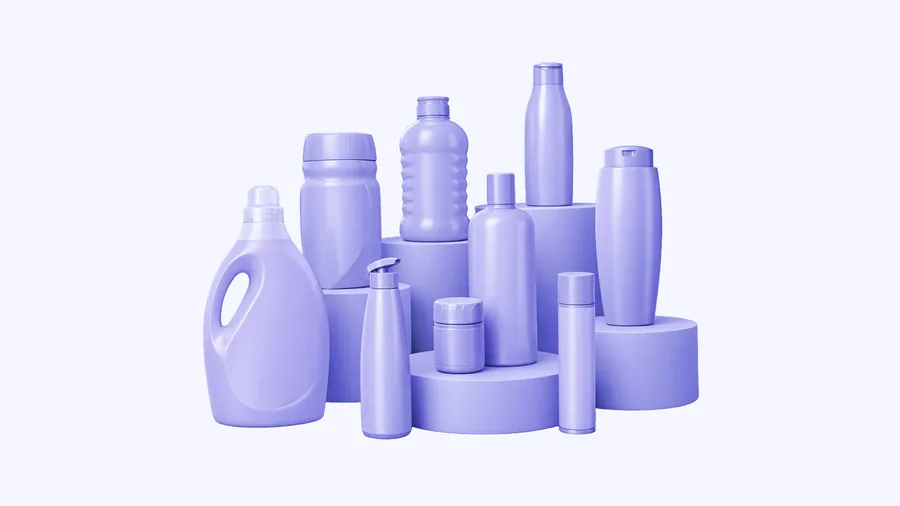
An FMCG container has to do two jobs that pull in opposite directions. It has to be distinctive enough that a shopper picks it up without deciding to, and cheap enough, per unit, that the brand can afford to make millions of it. Almost every interesting decision in this category lives in the gap between those two sentences.
We have spent more than twenty years in that gap: bottles, jars, closures and containers for food, beverage, home care and personal care, moulded by ISBM, EBM and injection moulding. What follows is what the category actually demands of a tool.
Volume changes what a second is worth
In most manufacturing, cycle time is a cost line. In FMCG it is the business case. A container running at ten million units a year on a multi-cavity tool turns one second of cycle into an enormous number, and it compounds, because a faster tool needs fewer machines, fewer operators and less floor.
This is why we design the cooling before we design the aesthetics. Cooling is what actually governs cycle time in a moulded part: the tool cannot open until the part is rigid enough to eject without distorting. Conformal cooling paths, gate position and the thermal behaviour of the steel decide that moment. A container that looks identical to its competitor can carry a cycle time twenty percent better purely because someone thought about heat first.
Lightweighting is a design problem, not a savings target
Every gram of resin removed is a gram multiplied by the run. The temptation is to treat lightweighting as a percentage to hit after the design is signed off. That is how you get a bottle that panels on the pallet.
Material has to come out of the places that were never carrying load in the first place, and stay in the places that are: the base, the shoulder, the neck finish, the top-load column. Finding those places means simulating the container before the tool exists: wall-thickness distribution, top load, drop, and the vacuum that forms as a hot-filled bottle cools. Done properly, a lighter container is also a stronger one, because the material ends up where the physics wanted it.
The closure is not an afterthought
Closures are where FMCG programmes quietly fail. The neck finish is an interface between two separately tooled parts, often made by two different suppliers, and it has to seal reliably across temperature, pressure and a consumer opening it with wet hands.
We build injection tooling for closures and caps alongside the container tooling, which means the neck finish is engineered as one system rather than negotiated across a gap. When the same team owns both halves of the interface, the tolerance stack is a decision instead of an accident.
Shelf presence is a tooling capability
Everything above is necessary and none of it sells anything. The container still has to be worth looking at, and distinctive geometry is exactly what conventional tooling tends to negotiate away. Deep grips, undercuts, asymmetric shoulders and sharp shape definition all get value-engineered into a soft rectangle unless the toolroom can actually hold them.
This is the part we care most about. A silhouette is one of the few pieces of brand equity a competitor cannot copy by changing a label. When the tooling can hold the shape, the shape can be the strategy.
Where to start
The cheapest time to involve a mould maker in an FMCG programme is while the container is still a sketch. Bring a drawing, a sample, or just an idea. You can also start on the platform and generate manufacturable concepts in minutes, then hand the one you like straight to our engineers.
Advanced Molds Technologies engineers and builds packaging tooling in Amman, Jordan, serving brands across Saudi Arabia and the GCC. If this piece is close to a problem on your line, our FMCG packaging molds are where to start.


