
Mold Manufacturing: How a Steel Block Becomes a Sampled Tool
A mold is not finished when machining ends — it is finished when it makes good parts. The full sequence from engineering and simulation to machining, polishing, assembly and first trial, and why the order of those stages matters.
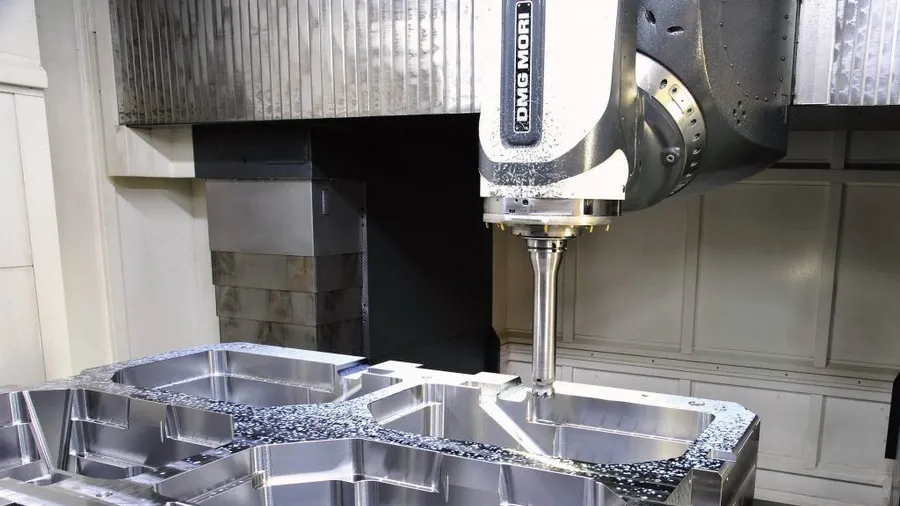
A finished mold looks inevitable: a steel block with a cavity in it, as if the shape had always been there. Nothing about it is inevitable. Mold manufacturing is a long argument between a drawing and a block of steel, settled in stages — some in software, some at the machining centre, some by hand with a stone and marking blue. The order of those stages decides whether a tool runs quietly for a decade or fights its operators from the first shift.
What the mold manufacturing process actually is
Mold manufacturing is the sequence that turns a design into a production tool: engineering and simulation, CNC machining, surface finishing, fitting and assembly, and a first trial on a molding machine. A mold is not finished when machining ends; it is finished when it makes good parts that measure to the drawing. At Advanced Molds Technologies in Amman, that entire sequence runs under one roof.
Each stage exists to catch a specific class of error while it is still cheap to fix. Skip one and the error does not disappear; it waits for a more expensive place to surface.
Engineering first: a mold is designed around a machine
No serious mold manufacturer starts with steel. The first work is done against the customer's machine, because a mold is not built for a part — it is built for a part on a specific press. Platen dimensions and tie-bar spacing decide the mold base. Neck standards decide the finish inserts. The plant's chilled-water supply decides how ambitious the cooling layout can be. A mold that ignores its machine gets re-engineered at the customer's plant, in the customer's downtime.
Then simulation. Flow, cooling, wall thickness, top load and drop behaviour are proven in software before steel is cut. It is the cheapest correction window the project will ever have: a change here costs a day of engineering; in steel, a re-cut. The details differ across the three tooling families — extrusion blow, injection and stretch blow — but the logic is identical. No material is ordered until the simulation and the customer have both signed off.
Machining: roughing is about speed, finishing is about truth
CNC machining a mold is two jobs done on one block. Roughing removes most of the material and is judged by how quickly it gets close. Finishing is judged by how exactly it stops: cavity surfaces cut to final geometry, often on multi-axis centres, because deep cavities and pinch areas need the cutter presented at angles a three-axis machine cannot reach. Where no cutter fits — sharp internal corners, deep ribs, fine lettering — electrodes are machined and the geometry is burned in by EDM.
The tolerances that matter most are not the glamorous ones. The parting line — the face where the two halves meet — is machined to tolerances that decide whether the closed mold seals. A parting line out by hundredths of a millimetre leaks flash on every cycle. The mold will still run — and every shift will pay for it in trimming.
Polishing: why hand finishing survives in a CNC world
A machined surface, however fine, carries tool marks, and what removes them is still largely human: stones, papers and diamond pastes worked in sequence by people who can feel a scratch a gauge would miss. The surface grade is matched to the part, because polish is a cost and should be spent where it returns. A bottle that must gleam on a shelf justifies a near-mirror cavity. An industrial fitting nobody looks at does not.
The parting line gets its own ritual: coated with marking blue, closed, opened, corrected, and closed again until the contact is even across the whole face. That patience is what a clean moulded seam looks like one step upstream.
Fitting and assembly: closed by hand before it sees a press
Assembly is where the mold becomes a mechanism instead of a kit of parts. Cooling circuits are pressure-tested: a leak on the bench costs an hour; in production it costs a stopped line and a corroding cavity. Ejection and every moving element are tuned until they run smoothly by hand — a movement that needs force on the bench will demand violence on the machine. Finally the mold is spotted and closed by hand. If two technicians cannot close it cleanly on a bench, the press will close it anyway, and print the mismatch into the steel.
The first trial: the mold proves itself
A mold trial is the tool's first day of work. It is mounted, brought to temperature, and run until a stable process window emerges — the range of settings within which good parts keep coming. Sampled parts are then measured against the drawing, not against enthusiasm: capacity, weight, wall thickness distribution, neck dimensions, fit with the closure. Anything out of tolerance is corrected, and the trial repeats.
A serious tool never ships alone. It ships with its samples and its settings sheet, so the customer's first run starts from a proven window rather than a guess.
What separates a mold manufacturer from a machining shop
Machining capacity can be bought. Three other things have to be built:
- Measurement culture: every stage is checked against numbers — simulation targets, machining tolerances, sampled-part dimensions — not against the eye of whoever finished last.
- Iteration under one roof: when a trial reveals a correction, the distance between trial machine and machining centre is a corridor, not a subcontract. Every loop that stays internal keeps days off the schedule, and waiting is most of what a mold actually costs.
- Life after delivery: molds wear and products change. A tool will want refurbishment, a cavity modification or spares within its working life, and the manufacturer who built it can service it in a way a machining vendor cannot.
From Amman, a finished mold reaches Saudi Arabia by road in days, and an engineer can stand at a customer's line anywhere in the GCC without crossing continents. Proximity matters most at these moments — trials, corrections, first production runs — when the moulding line is waiting and the clock is honest.
Mold manufacturing, answered
What are the steps of the mold manufacturing process?
Design and engineering around the customer's machine, simulation sign-off, CNC machining — roughing, finishing and EDM where cutters cannot reach — then polishing, assembly with pressure-tested cooling, and a first trial where sampled parts are measured against the drawing. The mold is finished when it makes good parts, not when machining ends.
Why are molds still polished by hand?
Because any machined surface carries tool marks, and the required finish varies with the part. Hand polishing matches the surface grade to the product — near-mirror for a bottle that sells on appearance, functional for a hidden component — and beds the parting line until the two halves seal evenly. Machines cut geometry; hands finish surfaces.
What is a mold trial and why does it matter?
A mold trial is the first controlled run of a new mold on a production machine. It finds a stable process window and measures sampled parts against the drawing: capacity, weight, wall thickness, neck dimensions. It converts the mold from a machined object into a proven tool — the customer receives samples and settings, not promises.
How is a mold maintained after delivery?
Ideally by the manufacturer who built it. Refurbishment restores parting lines, venting and cooling as the tool wears; modification adapts the mold when the product changes — a new neck standard, a weight reduction, new engraving; spares for wearing components keep small failures from becoming stoppages. A mold is a working asset with a service life, not a one-time purchase.
From steel to sampled tool
If you are choosing who builds your next tool, this is a fair checklist.
Advanced Molds Technologies is a mold manufacturer in Amman, Jordan, building and trialling extrusion blow, injection, ISBM and PET molds under one roof for customers across Jordan, Saudi Arabia, the GCC and the wider MENA region — and no mold ships before it has made good parts.


