
Precision Mold Manufacturing: EBM, Injection and ISBM Explained
A mould is the machine that makes the part, several million times, without drifting. What that demands, and how the three families of packaging tooling differ.
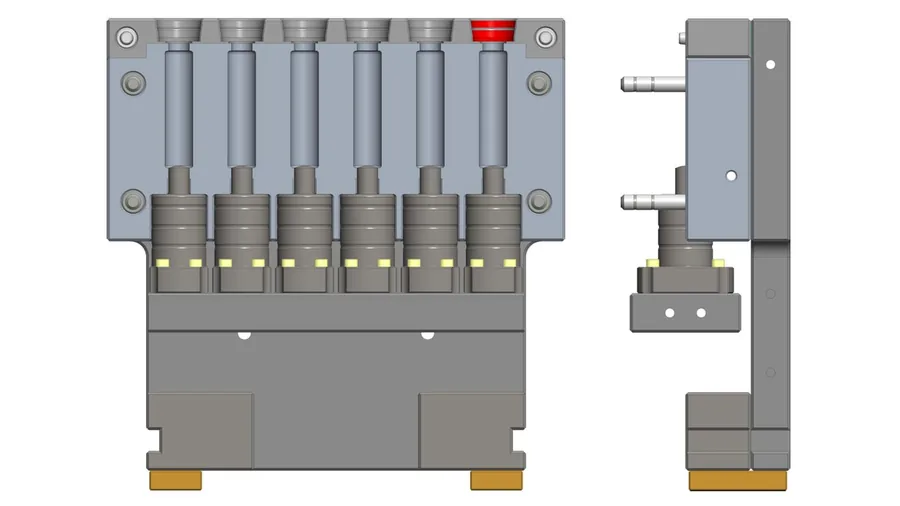
A mold is not a part. It is the machine that makes the part, several million times, without drifting. Everything below is what that demands, and how the three families of tooling we build differ from one another.
Packaging tooling gets judged on one thing in the end: whether the ten-millionth container matches the first. Getting there is less about any single clever feature than about controlling the whole chain, from the steel that arrives to the sampled parts that leave. That is why our design, machining, polishing, assembly and trials all sit under one roof in Amman.
The three families we build
Almost all rigid plastic packaging comes off one of three processes. They are not interchangeable, and the choice is usually settled by the container itself: its neck, its wall, its material and how many of them you need.
Extrusion Blow Molds (EBM)
In extrusion blow moulding, a molten tube of plastic is extruded, captured between two mould halves and inflated against the cavity wall. It is the workhorse for HDPE and PP bottles, jerrycans, and handled containers, and it is the only one of the three that produces a handle as part of the container.
The engineering lives at the pinch. Where the mould closes, it has to cut and weld the parison in the same motion, and the weld line it leaves is the container’s weakest point. Pinch geometry, land width and the cooling immediately around it decide whether a bottle survives a drop test. Deep pinch geometry and asymmetric parting lines let a container take shapes that a conventional straight parting line cannot reach, which is where most of the shelf differentiation in this process comes from.
- Best for: HDPE and PP bottles, jerrycans, handled containers, industrial packaging.
- Decides quality: pinch geometry, weld line strength, cooling balance across the cavity.
- Watch: wall distribution, since the parison thickness is controlled in time rather than by a core.
Injection Molds (IM)
Injection moulding fills a closed cavity with molten polymer under pressure. It is the most dimensionally precise of the three, which is why it owns closures, caps, dispensers, hinges and any part with a thread or a sealing face.
Multi-cavity tooling is where it gets difficult. A sixteen-cavity closure mould is sixteen moulds that must behave identically: fill at the same moment, cool at the same rate, and release at the same time. Runner balance, gate position and cooling symmetry are what make cavity four match cavity thirteen. When they do not match, you do not see it in the mould, you see it as leakers on the filling line.
- Best for: closures, caps, dispensers, functional components, thin-wall containers.
- Decides quality: runner and cooling balance across cavities, gate placement, venting.
- Watch: shrinkage and warp on sealing faces, where a few hundredths of a millimetre becomes a leak.
Injection Stretch Blow Molds (ISBM)
ISBM is a two-stage process: a preform is injection moulded, then reheated and stretched both axially and radially inside the blow mould. That biaxial stretch is what gives PET its clarity, its strength and its barrier performance, and it is the reason a water bottle can weigh a few grams and still hold pressure.
Most of the outcome is decided in the preform, not the bottle. Preform weight, wall profile and neck finish set the material distribution before the blow mould ever sees the part. The blow mould then controls the base, the shoulder and how evenly that material lands. Get the pairing right and the bottle is light, clear and stable; get it wrong and you find out at the base, under load, in a warehouse.
- Best for: PET bottles for water, beverages, edible oil, personal care and pharmaceutical packaging.
- Decides quality: preform and mould designed as one system, base geometry, stretch ratios.
- Watch: material distribution and base stability at high output.
Two adjacent families: PET blow molds and thin-wall tooling
Two more kinds of tooling sit beside the three above. PET blow molds serve two-stage reheat stretch blow lines, where bottles are blown from standard preforms bought rather than moulded in-line - the cavity, base and neck tooling decide the same things ISBM decides, without the preform side. And thin-wall injection molds push the IM discipline to its limit: walls under a millimetre, cycle times measured in seconds, and cooling that has to be perfect because there is no material to hide behind. We build both, on the same floor, under the same rule: the mold decides.
What happens between the drawing and the steel
A mould that is only designed well can still fail. These are the stages that stand between a good design and a tool that runs.
- Engineering review: the part is checked as something to be manufactured, not only as a shape. Draft, wall, parting line and ejection are resolved before anything is cut.
- Simulation: flow, cooling and wall thickness are proven in software, where a correction costs a day instead of a re-cut. This is the cheapest place to be wrong.
- Mold design: full 3D design of cavities, cores, cooling circuits, ejection and the mould base as one assembly.
- Machining: CNC and EDM to bring the cavity to its final geometry, with the hard-to-reach detail that only electrode work can produce.
- Polishing and fitting: the surface the customer eventually touches, and the precision fitting that decides whether the mould seals along its whole shut-off.
- Assembly and trials: the mould is run and sampled. Parts, not drawings, are the deliverable.
Why cooling is most of the argument
Cycle time is mostly cooling time, and cooling is where a mould quietly earns or loses money for years. A cavity that cools unevenly does not just run slower; it warps parts, shifts dimensions between cavities and pushes the moulder into compensating with pressure and time. Designing the cooling circuit as a first-class part of the tool rather than something routed in afterwards is one of the clearest differences between tooling that is cheap to buy and tooling that is cheap to own.
Building it in-house
Keeping design, machining, polishing, assembly and trials in one building is not only a scheduling advantage, though it is that. It is a feedback loop. The engineer who specified the cooling sees the sampled part. The toolmaker who fitted the shut-off hears what happened on the customer’s line. Tooling improves when the people who draw it and the people who cut it are in the same room, and it stagnates when they are not.
Considering a tooling programme? Tell us the container, the material, the process and the volume, and we will tell you honestly which of the three it should be.
Advanced Molds Technologies engineers and builds packaging tooling in Amman, Jordan, serving brands across Saudi Arabia and the GCC. If this piece is close to a problem on your line, our precision mold making in Amman, Jordan are where to start.


