
Mold Making and Design for Pharma and Medicine Packaging
In pharmaceutical packaging the container is part of the dose. Tolerances stop being a quality target and become a safety one, and the mold is where that argument is won or lost.
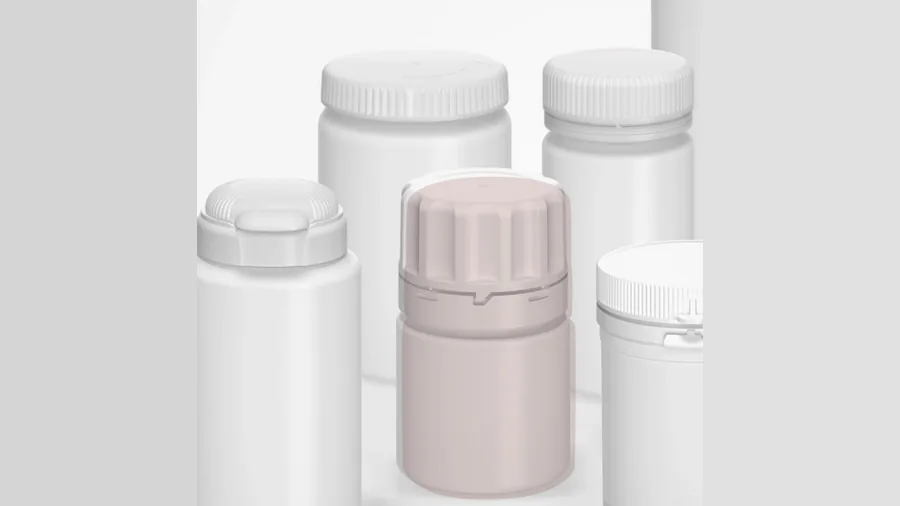
A shampoo bottle that dispenses ten percent more than intended is a minor annoyance. A dropper bottle that does the same thing is a dosing error. That single sentence is the whole difference between packaging and pharmaceutical packaging, and it changes every decision upstream of it, including the ones made in the toolroom.
Bottles, vials, droppers, closures, measuring devices and child-resistant systems: the category demands things no other category asks for.
The container participates in the dose
In most packaging the container holds a product. In pharma it frequently meters one. A dropper's orifice governs drop volume. A measuring cup's graduations are read by a parent at 3am. A dispensing closure decides how much comes out.
So a dimension that would be cosmetic elsewhere becomes clinical. The tolerance on an orifice is not a quality preference; it is the difference between a correct dose and an incorrect one, repeated across every unit the tool will ever produce. Multi-cavity injection moulds stop being an efficiency question and becomes the entire point: every cavity has to produce the same dose, not an acceptable average.
Contamination is designed out, not cleaned up
Pharmaceutical containers have to be cleanable, sometimes sterilisable, and above all must not contribute anything to what is inside them. That pushes back into the mould in specific ways: surface finish that does not harbour residue, geometry without dead corners, and a tool that will not shed anything into the part.
Material selection narrows sharply, to medical-grade resins with documented provenance, and no unapproved additives, mould releases or colourants. Some of the ordinary conveniences of moulding are simply unavailable, and the tool has to be designed on the assumption that they will not be there to rescue it.
Validation makes changes expensive
This is the part that most surprises people arriving from FMCG. In consumer packaging, a tooling tweak after launch is a cost and a delay. In pharma it can be a revalidation: documentation, qualification, potentially regulatory notification. The tool is part of a validated process, and the process was approved as it was found.
The practical consequence is that the front end has to be right, because the back end is closed. Everything we would normally be willing to correct at first sampling has to be resolved in simulation and engineering review first. It is the strongest possible argument for our digital-first approach: when a mould modification triggers a paperwork cascade, the value of finding the problem on a screen goes up by an order of magnitude.
Child resistance and its opposite
Child-resistant closures are a genuinely hard design problem, because the requirement is contradictory: hard for a child, easy for an arthritic eighty-year-old. Both are tested, and both are pass/fail.
That behaviour lives in the mechanical interaction of two moulded parts: the force to compress, the angle to turn, the engagement of the lugs. All of it is tooling tolerance. A closure that passes on the prototype and fails in production has usually not changed design at all; the cavities have simply drifted from one another.
Traceability is not optional
If a batch is ever questioned, the questions run all the way back: which cavity, which tool, which steel, which validation run. Cavity identification is designed into the tool from the beginning, because retrofitting traceability into a validated process is not a thing that happens.
Product design, mould engineering, simulation and manufacturing all sit under one roof, which means that chain is intact rather than assembled from three suppliers' records after the fact.
Start early
Pharmaceutical programmes reward involving the toolmaker before the design is frozen, because after it is frozen, the options are gone. If you are developing pharmaceutical or medical packaging, , ideally while it is still a drawing.
Advanced Molds Technologies engineers and builds packaging tooling in Amman, Jordan, serving brands across Saudi Arabia and the GCC. If this piece is close to a problem on your line, our pharmaceutical packaging molds are where to start.


